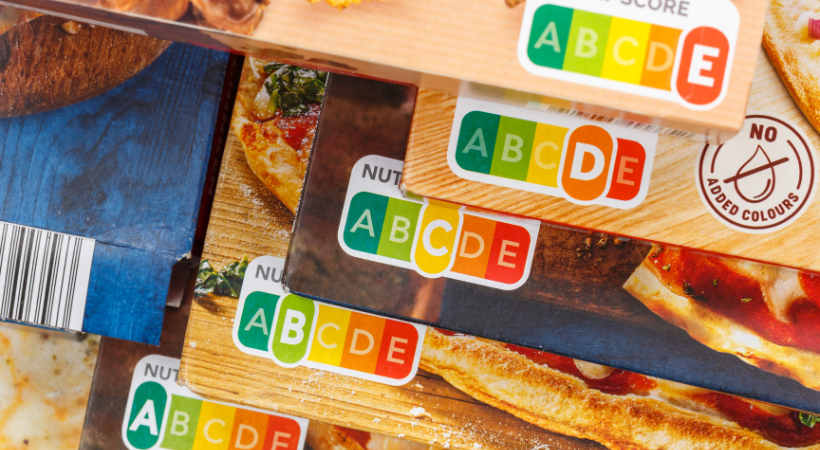
Unless exempt, all pre-packaged food must display a label with nutritional information, including energy value and the amounts of fat, saturates, carbohydrates, sugars, protein and salt. This allows shoppers to make informed food choices.
However, consumers don’t always have time to scrutinise and compare the nutritional information of every product they buy. As a result, some businesses choose to use Front-of-Pack (FoP) nutrition labelling to improve consumers understanding of the nutritional value of the food. This ‘simplified’ nutrition information aims to make it easier for people to quickly check the nutrients of a product using visual cues.
Examples of FoP nutrition labelling include voluntary schemes such as the traffic light system in the UK, and the Nutri-Score introduced by some EU Member States.
In the following article, we explore the Nutri-Score system in depth to help food businesses learn more about when and how to use this on their labels.
In the EU, the Nutri-Score scheme has been adopted by several Member States on a voluntary basis. Like the UK’s traffic light system, the Nutri-Score labelling system is a front-of-pack labelling scheme that provides a visual cue for shoppers to compare products and make an informed decision about which they buy.
It was developed by Santé Publique France (Public Health France) and introduced in the country in 2017. The score is calculated using a product’s composition and this is represented on front of pack labelling as a chart using traffic light colours and an alphabetical score from A to E – with A being the better nutritional option, and E being a poorer one.
Since 2017, France and six other countries have committed to the Nutri-Score system, including Spain, Germany, Switzerland, Belgium and Luxembourg. The Netherlands also adopted it as its official voluntary nutrition labelling scheme on 1st January 2024.
Businesses who want to use the Nutri-Score on their food and beverage products must register their brand(s) with Santé Publique France and comply with the user regulations. Registration is free and you only need to register once to use it across the various permitted markets. However, some markets do require you to notify them that you will be using Nutri-Score.
If you choose to implement the Nutri-Score system, this must be done across your entire brand portfolio of products – you can’t selectively choose some products and leave the others.
The Nutri-Score label uses a 5-colour system (from dark green to dark orange), accompanied by five letters (A-E).
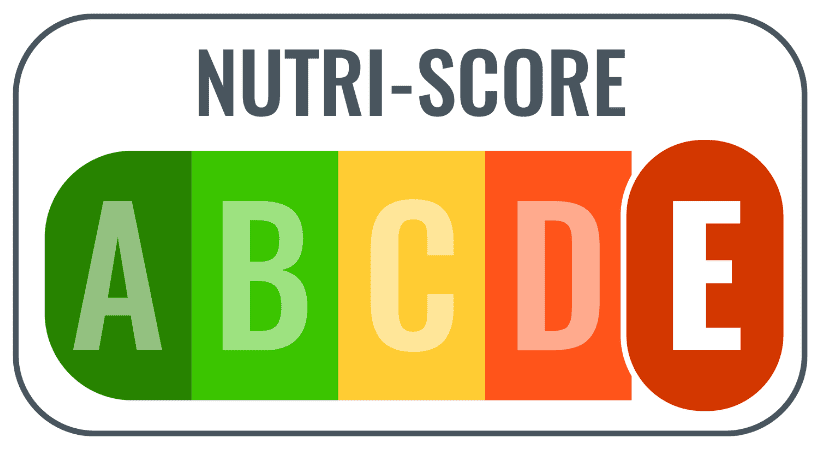
The Nutri-Score is calculated by assigning different nutrients and ingredients in your product with positive or negative points. The final nutritional score for a food is found by subtracting the total number of positive points from the total number of negative points. Based on this you can determine which colour/letter combination your product falls in.
Calculating an accurate score is the most complex aspect of implementing the Nutri-Score on your products. This is because the evolving scoring algorithm has various exceptions and nuances depending on the category of your products. Additionally, because of industry feedback, changes to the algorithm happen regularly, so keeping your calculations up to date is a challenge many businesses face. Details of the calculation can be found on the Santé Publique website.
Calculating the percentage of fruit, vegetables and legumes is particularly tricky. For example, potatoes are excluded from the calculation of the fruit, vegetable and legumes %, so will not count towards favourable points, nor will flour from legumes such as lentils due to the processing involved (sorry lentil chips!). The type of coconut you use, such as extract, desiccated or whole will impact the value it contributes to your products, and you will also need to consider the impact of concentrates on your score, which don’t count unless reconstituted.
When it comes to using the Nutri-Score logo on your label, there are extensive graphic charter guidelines available – follow these closely and be careful not to use a vertical chart, unless this is a last resort.
As mentioned, the Nutri-Score calculations are changed in response to industry feedback to reflect the nutrition of products more accurately. Examples of such changes in recent years include:
No. The Nutri-Score system remains voluntary in the EU, at least for now. The European Commission committed in its ‘Farm to Fork’ strategy, launched in May 2020, to propose harmonised mandatory front-of-pack nutrition labelling by the end of 2022. This deadline has now passed and the promised proposals do not seem forthcoming.
This is unfortunate considering that consumer and health associations see FOP nutrition labelling as key to helping consumers make more informed, healthier food choices.
Nevertheless, the Nutri-Score has proved controversial for penalising products without considering wider health benefits. There is also general criticism of such schemes, arguing that they are over-simplified and can mislead consumers.
Since the scheme is voluntary, there is no legal requirement to display a Nutri-Score label. However, it may help to build consumer confidence and help your products stand out on the shelves, especially if they have a more favourable Nutri-Score rating than your competitors’. Understanding what is typical practice in your markets of sale is important, which is where local experts such as Ashbury can support. If you choose to implement Nutri-Score, this must be done across your entire brand portfolio.
Ashbury has extensive experience working with brands to calculate and display their Nutri-Scores, and offer end-to-end support with food labelling compliance.
As part of our artwork check service, we ensure the use of the Nutri-Score is permitted in the markets you intend to sell in, and if so, that the charts you are using follow the relevant user regulations and graphic charter.
Our team can also help you to calculate your Nutri-Score or ensure that your calculations are correct and up to date. We work with the most up to date Technical and Scientific Q&A documents to establish what counts and how it counts, so you can accurately score your products.
If you’d like to speak to an expert about the use of Nutri-Score labels on your products, please get in touch with our team today.

 Back to Articles